If you are currently serving in the Australian Defence Force or have recently transitioned out, chances are you have typed some version of the same question into Google: show me an ADF resume example? what is a good ADF resume actually supposed to look like? How do I write a defence resume when I have never needed one before? What does a military to civilian resume in Australia even look like? How do I translate ten years of service into something a civilian employer can understand?
It is a fair question, and one we hear constantly. Most Defence members have spent years, sometimes decades, having their career managed through the military system. Performance documented in PARs. Qualifications tracked in PMKeyS. Postings assigned by Career Management. The civilian job market works nothing like that, and the gap between a service record and a resume that speaks to a civilian employer can feel enormous.
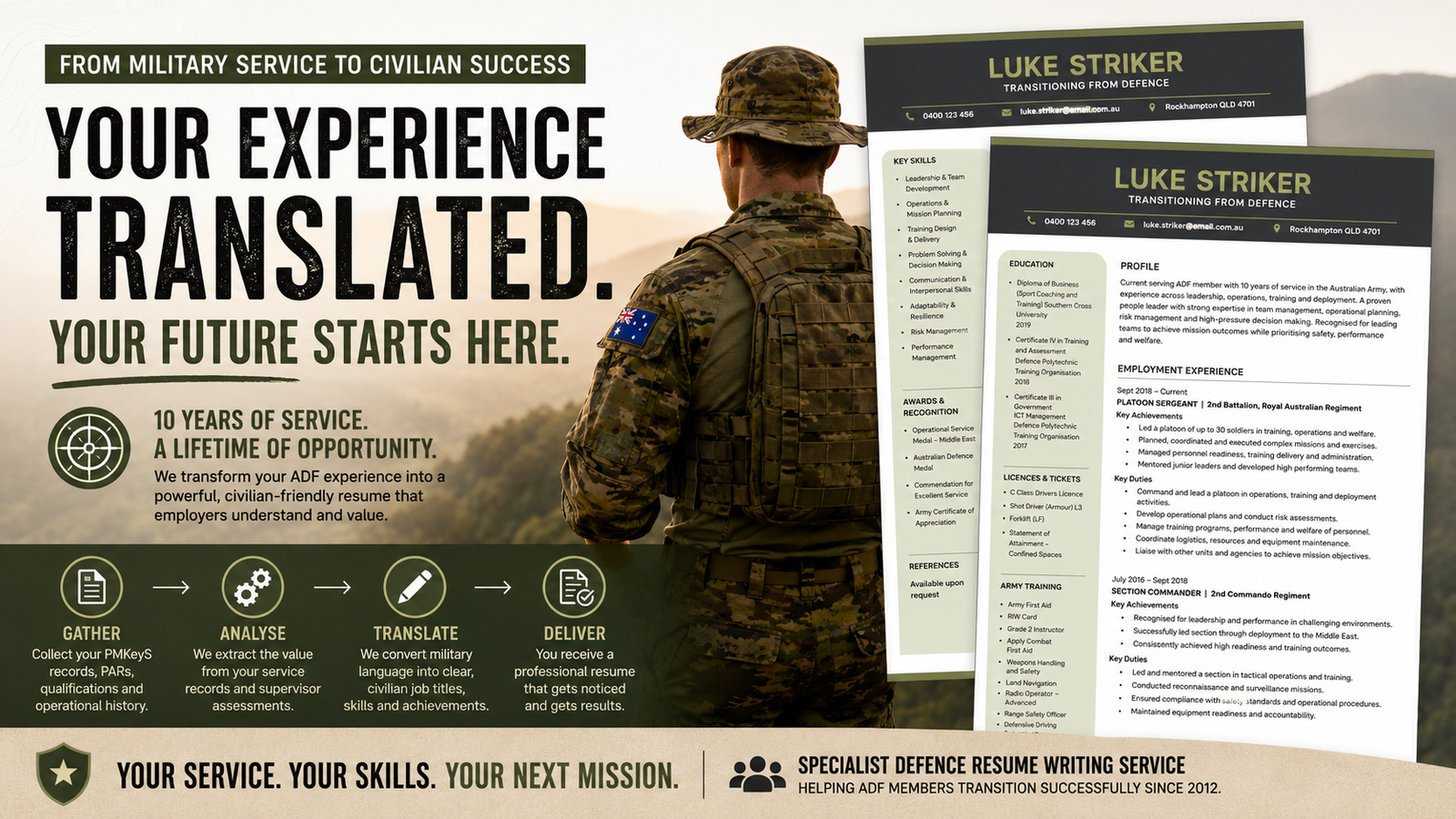
In this post we are going to walk through a real ADF resume example based on a composite of our clients. Our client is a serving Army Sergeant with approximately ten years of service across operational, training and leadership roles. We will show you what the raw material looks like coming out of the Defence system, and how a professional defence resume writing service transforms it into something civilian employers can actually read and act on.
Why Most Defence Members Struggle to Write Their Own ADF Resume
It is not a lack of experience that makes writing an ADF resume hard. If anything, it is the opposite. After years of service, most Defence members have more demonstrated capability, more leadership experience and more formal qualifications than most civilian candidates at the same career stage. The problem is that almost none of it arrives in a format a civilian employer can understand.
Consider what a posting history looks like straight out of PMKeyS. Job titles appear as abbreviated military codes. Role descriptions are written for internal military audiences, full of doctrine references, acronyms and rank-specific language that means nothing to a hiring manager in operations, construction, security or government.
Then there are the PARs. Your Performance Appraisal Reports are rich with evidence of your capability, written by supervisors who have observed you directly over sustained periods. But most Defence members have never thought to use that language in a resume. They either ignore the PARs entirely or attempt to summarise their career from memory, which almost always results in underselling. That is exactly where a specialist defence resume writing service earns its value.
The Raw Material: What We Start With in a Real ADF Resume Example
To show you how this works in practice, let us walk through the documents we typically start with. For this example, our client is a serving Army Sergeant with around ten years of service across infantry and mechanised roles, including a posting as an instructor at a training establishment and a deployment to the Middle East.
Their raw documents included:
- A posting history from PMKeyS showing a series of roles with abbreviated position codes and unit identifiers across multiple battalions and training establishments
- A promotion history showing rank progression from Private through to Sergeant, with each rank linked to a mustering and skill grade that means nothing outside the military system
- Three years of Performance Appraisal Reports across two different PAR formats, each containing detailed assessments from direct and senior supervisors across Defence Mastery, Social Mastery and Technical Mastery
- A comprehensive course and qualifications history across more than 150 entries, from weapons qualifications and range safety certifications through to instructional courses, leadership programs and mandatory training
- Operational service records showing a Middle East deployment and the associated medals and commendations received
On their own, these documents are thorough. But to a civilian employer, they are largely unreadable. Our job is to extract everything of value and translate it.
How We Transform a Posting History Into Civilian Job Titles
The first step in building any ADF transition resume is making sense of the posting history. For our client, their PMKeyS record showed a decade of positions all listed in abbreviated military notation, with multiple consecutive postings that served essentially the same function under different unit codes.
Our process involves two key steps: consolidating roles where the core function was the same across multiple postings, and rewriting every title in plain English that reflects the actual work performed. Here is how that looked in practice:
| Raw PMKeyS Position Title | Civilian Resume Title |
| 8 PL SGT, INF BN | Platoon Sergeant, Infantry Battalion |
| SPV PL OPS SPEC, INF BN | Specialist Platoon Operations Supervisor, Infantry Battalion |
| SPV SECT OPS SPEC, MECH CELL | Mechanised Section Operations Specialist |
| ASST INSTR MECH CELL, TACTICS WG | Assistant Instructor, Mechanised Infantry Cell, Tactics Wing |
| RFN, INF BN | Rifleman, Infantry Battalion |
We also consolidated multiple consecutive postings with the same function into single role entries with a combined date range. This prevents the resume from looking fragmented and ensures the reader sees a coherent career story rather than a confusing list of short-term positions.
The Platoon Sergeant role, for example, requires significant unpacking for a civilian audience. A serving Army Sergeant responsible for a mechanised infantry platoon of up to 30 soldiers is effectively a senior team leader and operations supervisor managing personnel, equipment maintenance, training delivery, administration and welfare simultaneously. None of that is visible in the raw PMKeyS title.
Mining the PARs: Where the Best ADF Resume Content Comes From
Performance Appraisal Reports are one of the most consistently underused sources of resume content we encounter. Most Defence members either do not think to reference them or assume the military language makes them unusable. Neither is true.
PARs contain detailed, supervisor-verified assessments of leadership, technical skill, judgement, adaptability and character. When reframed correctly, this language becomes powerful profile content, achievement statements and key skills language that is credible precisely because it came from someone who observed the person directly over an extended period.
For our client, their PARs contained supervisor assessments along these lines:
| HOW PAR LANGUAGE BECOMES RESUME CONTENT PAR Supervisor Comment “Our client has consistently performed above worn rank and is a force multiplier for the unit. They excel in the Mechanised Infantry space and have been relied upon for the development and conduct of integrated ranges from platoon to brigade level.” Becomes in the Resume Profile: “An experienced mechanised infantry specialist with a demonstrated ability to lead, train and develop personnel across platoon and unit-level operations, recognised for consistently performing above substantive rank across multiple reporting cycles.” PAR Supervisor Comment: “Our client is a natural leader. Their dedication and competence is the standard that both officer and other rank trainees try to emulate. They possess excellent technical proficiency in their trade and continue to develop themselves to master it.” Becomes a Key Skills Bullet: “Natural leadership ability with a proven capacity to set the standard and inspire others, consistently recognised by supervisors for technical excellence and a commitment to developing those around them.” |
This process is applied across every available PAR. The goal is to identify specific, evidence-based language that speaks to leadership, communication, technical competency and character, then translate it from military assessment language into civilian resume content. The result is language that is specific and credible, two qualities that generic, self-written resumes almost always lack.
What the Finished ADF Resume Example Looks Like
Once all the raw material has been processed, the final resume tells a clear, compelling and civilian-friendly story. For our client, the finished document included:
- A strong profile section positioning them as an experienced infantry leader and qualified military instructor, without a single piece of unexplained military jargon
- A key skills section grounded directly in PAR language, covering leadership, communication, problem solving, adaptability and team development in plain English
- Four consolidated role entries with clear civilian job titles, concise duty descriptions and targeted achievement statements drawn from real events, exercises, deployments and supervisor assessments
- An education and qualifications section highlighting transferable credentials including Platoon Sergeant Supervisory course, Senior Range Advisor qualifications, Army Combative Program Instructor, and First Aid certifications
- Operational service and medals listed as a standalone awards section, giving proper recognition to their deployment history without burying it in a duties list
The result is a document a civilian hiring manager in operations management, security, emergency services, construction, government and so on, can read in under a minute and immediately understand the calibre of person in front of them.
What to Gather Before You Start Your Own ADF Transition Resume
If you are beginning to think about your civilian resume before reaching out to a professional, here are the most important documents to gather first:
- Your Service Record Report from PMKeyS, which contains your full posting history, promotion record and course history
- Any PARs you have access to, particularly the supervisor narrative sections rather than just the ratings
- A note of any occasions where you performed above your substantive rank, led a team through a specific challenge or took on additional responsibilities
- Details of all deployments, operational service and any medals, commendations or formal recognition received
- A list of qualifications you believe have civilian equivalance, such as first aid, driving licences, safety certifications and instructional qualifications
If you have access to your PARs, read through the supervisor comment sections and highlight any specific language about your leadership, technical ability or character. That is where the most valuable resume content is sitting, largely untouched.
If you are not sure where to begin or you want a professional to manage the translation process for you, our defence resume writing service has been working with ADF members since 2012.
Mid Career – Junior Ranks & Technical Roles
For Defence members in trade, technical, and specialist roles across Army, Navy, and Air Force at any stage of their career.
Examples: Army – Private/Lance Corporal; Navy – Seaman/Able Seaman; Air Force – Aircraftman/Leading Aircraftman.
- 5-7 Day Turnaround
- Professional Resume Writer
- ATS and Keyword Optimised
- Professional and Modern Design
- Content Tailored for Role and Industry
- Editable Word and PDF Format
- Discounted Rates for Packaging Other Services
- Unlimited Revisions for 14 Days
- Express Options
Leaders – NCOs & Warrant Officers
For team leaders and senior leaders.
Examples: Army – Corporal, Sergeant | Navy – Leading Seaman, Petty Officer | Air Force – Corporal, Sergeant
- 5-7 Day Turnaround
- Professional Resume Writer
- ATS and Keyword Optimised
- Professional and Modern Design
- Content Tailored for Role and Industry
- Editable Word and PDF Format
- Discounted Rates for Packaging Other Services
- Unlimited Revisions for 14 Days
- Express Options
Executive – Senior NCOs, Warrant Officers & Officers
For Warrant Officers and senior Commissioned Officers moving into senior management, director, and executive roles in civilian industries.
Examples: Army – WO1, Lieutenant Colonel and above | Navy – Warrant Officer, Commander and above | Air Force – Warrant Officer, Wing Commander and above
- 5-7 Day Turnaround
- Professional Resume Writer
- ATS and Keyword Optimised
- Professional and Modern Design
- Content Tailored for Role and Industry
- Editable Word and PDF Format
- Discounted Rates for Packaging Other Services
- Unlimited Revisions for 14 Days
- Express Options
Frequently Asked Questions
Q1. How do I explain my military rank on a civilian resume?
Simply listing a rank without context means very little to a civilian employer who may have no knowledge of the ADF rank structure. The more effective approach is to contextualise the rank alongside your job title and include a brief indication of what it meant in practice, such as the number of people you led, the scope of your responsibilities or the level at which you operated. A well-written ADF resume example will always translate rank into responsibility, so the hiring manager understands the seniority of the role without needing a military background to interpret it.
Q2. Can I use my PAR content on a civilian resume even though it uses military language?
Yes, and we strongly encourage it. PARs are one of the richest sources of credible, evidence-based resume content available to any ADF member. You do not copy the language verbatim, rather a professional defence resume writer extracts the key themes and translates them into civilian achievement language. Supervisor comments about leadership, judgement, technical proficiency and adaptability are particularly valuable because they are independently verified observations from someone who watched you perform over a sustained period. That kind of credibility is hard to replicate from a self-written resume.
Q3. I have served in multiple units with similar roles. How do I avoid my resume looking repetitive?
This is one of the most common challenges in building an ADF transition resume, particularly for members who have held the same mustering across multiple postings. The solution is consolidation combined with progression. Where two or more postings involved the same core function, they are combined into a single role entry with the earliest start date and the most recent end date. Within that entry, achievements are used to show how the role evolved or how performance improved over time. This keeps the resume concise while still capturing the depth of experience the member actually has.
Q4. Does my deployment experience belong on a civilian resume?
Absolutely, and it should be treated as a significant achievement rather than a footnote. Operational deployments demonstrate a level of resilience, adaptability and professional commitment that most civilian candidates simply cannot match. They should be presented clearly with the operation theatre, approximate dates and your role, followed by any medals or commendations received in a dedicated awards section. If your deployment involved working alongside allied forces or in a multinational environment, that is also worth including as it speaks directly to cross-cultural communication and teamwork skills that civilian employers value highly.
Q5. How long should a Defence-to-civilian resume be?
For most ADF members with more than five years of service, two pages is the right target. Members with ten or more years of service across multiple distinct roles can justify two to three pages, provided every section earns its place. The goal is not to document every posting or every course completed but to present the most relevant experience in the clearest possible format. A well-constructed army resume example always prioritises the quality and relevance of content over volume, and every bullet point should either demonstrate a skill or prove a result.
Q6. What civilian industries are most receptive to hiring ADF Sergeants and Senior NCOs?
The industries that most consistently recognise and value what a Senior NCO brings include resources and mining, security and protective services, emergency management and emergency services, construction and infrastructure, logistics and supply chain, and government and public sector roles including law enforcement and corrections. In each of these environments, the leadership, technical discipline, operational planning experience and ability to perform under pressure that a Sergeant brings are directly transferable. The key is ensuring the resume presents those capabilities in the language those industries use, which is where a specialist defence resume writing service makes the difference.
Still have questions? Feel free to reach out to us below. We will respond within a few hours.