You’ve spent years building real skills — welding to code, working with high-alloy materials, passing NDT inspection after inspection. But when it comes to writing a resume, most boilermakers and pressure welders hit a wall. How do you get all of that experience onto paper in a way that actually makes a hiring manager stop and call you?
The good news is that a trades resume follows a specific structure, and once you know what employers and labour-hire contractors are looking for, it becomes much easier to write. Here’s a complete guide to boilermaker resume tips that will help you produce a document that works as hard as you do.
Why Most Pressure Welder and Boilermaker Resumes Fall Flat
The most common mistake tradespeople make on their resume is being too vague. Phrases like ‘carried out general welding duties’ or ‘performed fabrication tasks’ tell a recruiter almost nothing. They don’t know what processes you use, what materials you’ve worked on, what standards you weld to, or whether you’ve ever passed an X-ray inspection.
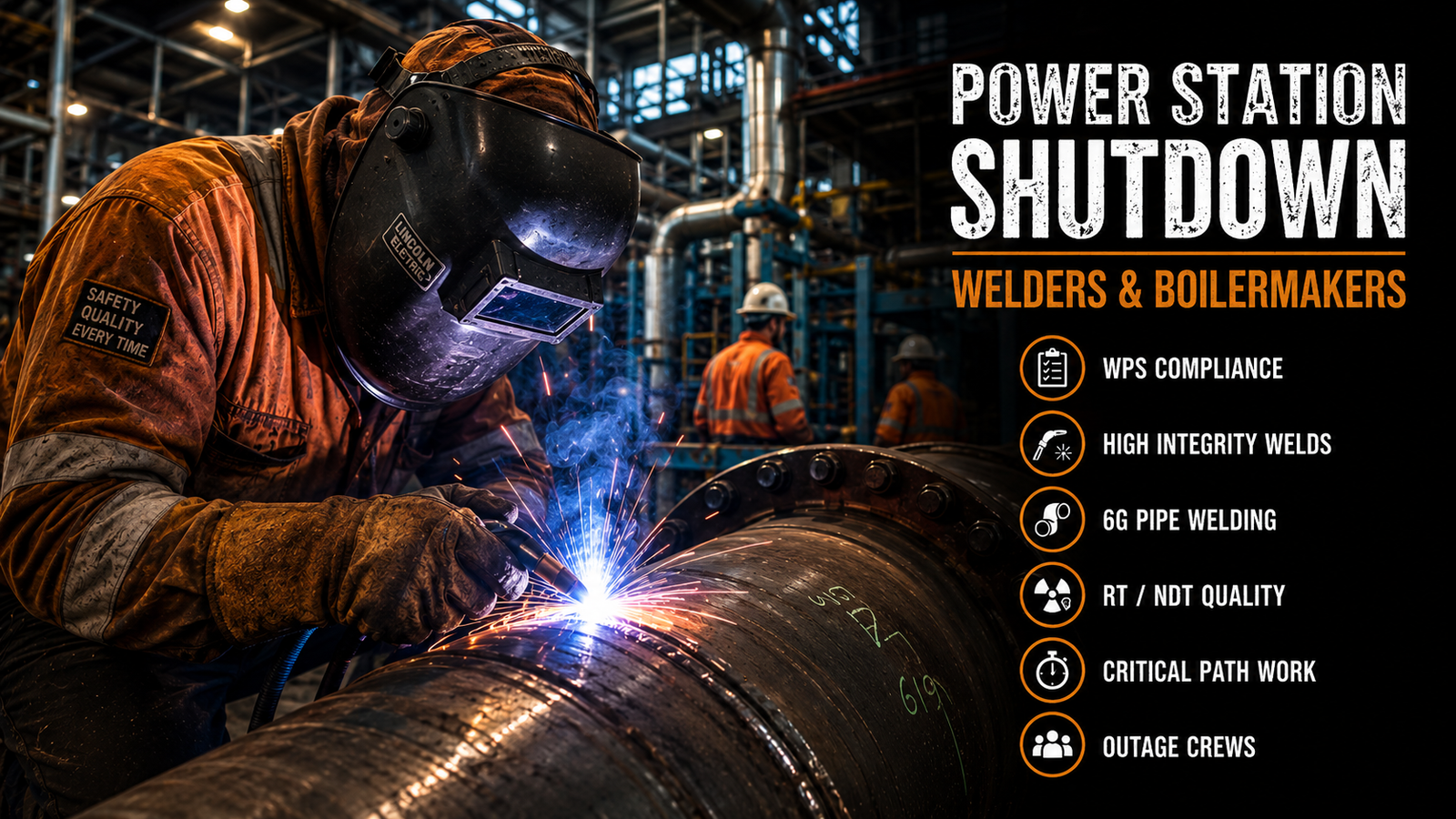
When a contractor is putting together a crew for a planned power station outage or a chemical plant shutdown, they’re looking for specific competencies. They need to know — quickly — whether you can TIG root P22 in a 6G position, whether you’ve worked in a confined space under a PTW system, and whether you’ve had welds accepted under 100% RT. If your resume doesn’t answer those questions, it goes in the maybe pile at best.
The solution isn’t to write more, it’s to write smarter! Every line of your boilermaker resume should be earning its place.
Pressure Welder and Boilermaker Resume Tips: Structure That Works
A strong trades / boilermaker resume has a clear, logical structure. Here’s what to include and in what order:
- A short profile (4–5 sentences) that tells the reader who you are, what your specialisation is, and how many years of experience you have. Keep it factual, not fluffy.
- A skills sidebar or panel covering your weld processes, materials, applicable standards, licences and tickets, and any software or drawing interpretation skills.
- Employment history in reverse chronological order, most recent role first. For each role, include the employer, your job title, dates, location, and whether it was local, DIDO, or FIFO.
- Under each role: key duties written in specific, technical language, plus a separate achievements section with measurable outcomes where possible.
- Referees: if you include these in you resume then you ideally want a mix of direct supervisors, QA leads, and project managers who can speak to your technical ability.
How to Write Duties That Actually Mean Something
This is where most trades and boilermaker resumes lose the reader. Generic duty lists read as filler. Specific duty lists read as evidence of competence.
Compare these two examples for a boilermaker working on a power station outage:
WEAK: ‘Carried out welding and fabrication duties on site.’
STRONG: ‘Performed GTAW root and SMAW fill/cap on SA-213 T22 superheater tubes in 5G and 6G positions; applied pre-heat using induction blankets and maintained interpass temperature records to approved WPS at mandatory hold points.’
The second version tells a contractor exactly what they need to know. It names the process, the material, the position, and the quality system requirements. That’s the level of detail that gets you on a shutdown roster.
When writing your duties, ask yourself: what would a C10 supervisor or QA inspector want to know about this job? Then write to that standard.
How to List Weld Qualifications and NDT Certifications on Your Boilermaker Resume
Your qualifications and certifications belong in two places on your boilermaker resume: in the dedicated section (for quick scanning) and in the body of the relevant role (for context).
In the dedicated section, list your weld processes clearly — GTAW/TIG, SMAW, FCAW, orbital TIG, and so on — alongside the materials you’re qualified on (P22, P91, Inconel, 316L stainless) and the standards you weld to (AS 4041, AS/NZS 3992, AS 1210).
If you’ve passed NDT inspections — radiographic testing, dye penetrant, TOFD, or UT — note this in the dedicated section. If you can state your RT first-pass acceptance rate for a specific project, include it as an achievement under that role. A statement like ‘Maintained 100% first-pass RT acceptance rate across all scopes including 100% RT chemical service piping’ is far more compelling than simply listing ‘RT qualified.’
If you’ve completed supervisor-administered qualification tests before outage engagements — which is standard practice at most power stations — note this under the relevant role. Recruiters understand what it means and it reinforces your professional credibility.
Achievements: The Section Most Tradies Skip
Achievements are the part of a trades resume that most people leave blank, and it’s a significant missed opportunity. Hiring managers and contractors use achievements to distinguish between candidates who do the work and candidates who do it exceptionally well.
For a boilermaker or pressure welder, strong achievements might include:
- First-pass RT acceptance rate across a project (e.g. ‘100% first-pass RT on 26 main steam welds across a Liddell-equivalent outage scope’)
- Being repeatedly re-engaged by the same contractor or client across multiple outages — this signals trusted familiarity with plant and scope
- Completing a specialist repair such as temper bead welding or dissimilar metal welds under close QA supervision
- Contributing to an outage finishing on schedule or recovering lost time on a critical path scope
If you’re struggling to identify achievements, think about it this way: what would your supervisor say about you if a new contractor called them for a reference? Write that down.
A Note on Earlier Experience
If you have 15 or 20+ years in the trade, you don’t need to give every early role the same level of detail as your recent work. Create an ‘Earlier Experience’ or ‘Early Career’ section near the bottom of your resume with one tight summary sentence per role. This keeps the document focused on your most relevant and recent work while still showing the depth of your career history.
Get Professional Help With Your Boilermaker Resume Tips Into Action
If you’ve been relying on the same resume for years — or copying and pasting old duty lists from a template — it’s worth investing in a professional rewrite. At Perth Resumes R Us, we specialise in writing resumes for tradespeople, including boilermakers, pressure welders, pipefitters, and fabricators. We know the industry, we know the terminology, and we know what shutdown contractors look for on paper.
Our team has been writing trades resumes since 2012. We’ll work with you to dig out your achievements, translate your technical skills into compelling language, and produce a document that opens doors to better-paying, higher-profile work.
Visit our Career Hub for more tips or if you’d like to engage our services, feel free to place an order below.
Section 4 — FAQ
Q: How long should a boilermaker / pressure welder resume be?
There’s no strict rule, but most experienced boilermakers end up with a 2-4 page resume once their full career history is properly documented. If you’ve worked across multiple outages, power stations, and project types, a longer document is entirely appropriate — and expected. The key is that every page should be earning its place. Avoid padding with generic phrases, but don’t truncate real experience just to hit a page limit.
Q: Should I include every single job I’ve ever had on my resume?
Not necessarily. For roles more than 10–15 years ago, a one-sentence summary in an ‘Earlier Experience’ section is usually enough. Focus the detail on your most recent and most relevant roles — particularly any outage, shutdown, or high-integrity pressure welding work. Early general labouring or unrelated jobs can be omitted entirely without raising questions.
Q: How do I show my weld positions on my resume?
List them in your skills section using standard AWS/AS notation — 1G, 2G, 5G, 6G, and so on. If you’re qualified in restricted-access or high-restraint positions, call that out specifically. You can also reference weld positions in your duty descriptions — for example, ‘performed GTAW root on boiler tubes in 5G/6G positions’ gives a QA inspector or C10 supervisor an immediate sense of your capability.
Q: What’s the best way to handle gaps in my employment history on a trades resume?
Short gaps (a few months) between outages or contracts are entirely normal in the trades and don’t need to be explained. Longer gaps — a year or more — are worth addressing briefly in your cover letter or profile section if there’s a good reason (injury, family, further training). Don’t try to hide gaps by leaving dates vague; experienced recruiters will notice and it raises more questions than it answers.
Q: Do I need a cover letter with my trades resume?
For most labour-hire and contractor applications, a cover letter isn’t essential — but a strong one can still make a difference, particularly if you’re applying for a leading hand or supervisory role. Keep it short (half a page), specific to the company and role, and focused on what you bring that’s directly relevant to their current scope. If you’re applying cold to a contractor you haven’t worked with before, a brief tailored cover letter shows initiative.
Q: How do I reference pre-outage weld qualification tests on my resume?
Many power station and chemical plant contractors require welders to complete a qualification test before each engagement — this is standard practice and worth noting on your resume. Under the relevant role, include a brief line such as ‘completed pre-outage weld qualification test per employer WPS requirements.’ This signals to contractors that you understand the qualification process and are comfortable with it, which builds confidence in your professionalism.